Workers servicing machinery shouldn’t gamble with their lives. Yet every year, preventable injuries occur because equipment is accidentally energized during maintenance. Lock out tag out safety—the systematic process of de-energizing machines and securing them with locks and tags—is not just a protocol. It’s a lifeline.
OSHA estimates that proper lock out tag out safety procedures prevent 120 fatalities and 50,000 injuries annually in the U.S. alone. Despite this, noncompliance remains widespread. Misunderstandings, inconsistent application, and poor training turn what should be a safety net into a liability.
This article breaks down what lock out tag out safety truly demands—not just in policy, but in practice. From real-world missteps to industry-specific applications, you’ll gain actionable insight into implementing a system that works.
What Lock Out Tag Out Safety Actually Means
Lock out tag out safety (LOTO) is a formalized process to isolate and secure machinery from all energy sources before maintenance or servicing. The goal? Eliminate the risk of unexpected startup or release of stored energy.
At its core, LOTO involves two key components: - Lockout: Applying a physical lock to an energy-isolating device (like a circuit breaker or valve) so only the authorized worker can re-energize it. - Tagout: Attaching a visible warning tag that identifies the worker, date, reason for isolation, and a clear “Do Not Operate” message.
While often used together, lockout is more secure than tagout alone—tags can be ignored, but a lock physically prevents activation.
The process applies to all types of hazardous energy: - Electrical - Mechanical - Hydraulic - Pneumatic - Chemical - Thermal - Gravitational (e.g., suspended loads)
A common misconception is that LOTO only applies to large industrial equipment. In reality, it’s relevant wherever energy isolation is needed—even conveyor belts, mixers, or office printers undergoing internal repairs.
Why LOTO Procedures Fail in Real Work Environments
Even when companies have written LOTO procedures, execution often falls short. The gap between policy and practice is where accidents happen.
1. Incomplete Energy Source Identification Workers may lock out the main power switch but overlook secondary sources. For example, a hydraulic press might be electrically disconnected, but residual pressure in lines can still cause movement. A 2021 incident at a Midwest manufacturing plant injured a technician when a spring mechanism released after a valve was opened—energy that wasn’t accounted for in the LOTO checklist.
2. Group Lockout Confusion In team maintenance tasks, the "group lockout" system is often poorly managed. Only one person (the primary authorized employee) should apply the lock, but all team members must attach their own lock to the same device. Skipping this step—or using a single master lock—undermines accountability.
3. Tag Reliance Without Locks Some workplaces use tags without locks, especially in environments where locking isn’t practical. But OSHA allows this only if the tagout system provides equivalent protection—something few organizations can prove. Tags are informational; locks are preventive.
4. Temporary Re-energization for Testing Workers sometimes briefly restart equipment during diagnostics. If the LOTO procedure doesn’t clearly define how to safely re-energize and re-isolate, the risk spikes. The rule: every re-energization requires a full reassessment and reapplication of locks.

5. Inadequate Training Training often covers theory but not real-world complexity. A maintenance worker trained only on one machine type may not recognize energy hazards on a similar-looking unit with different isolation points.
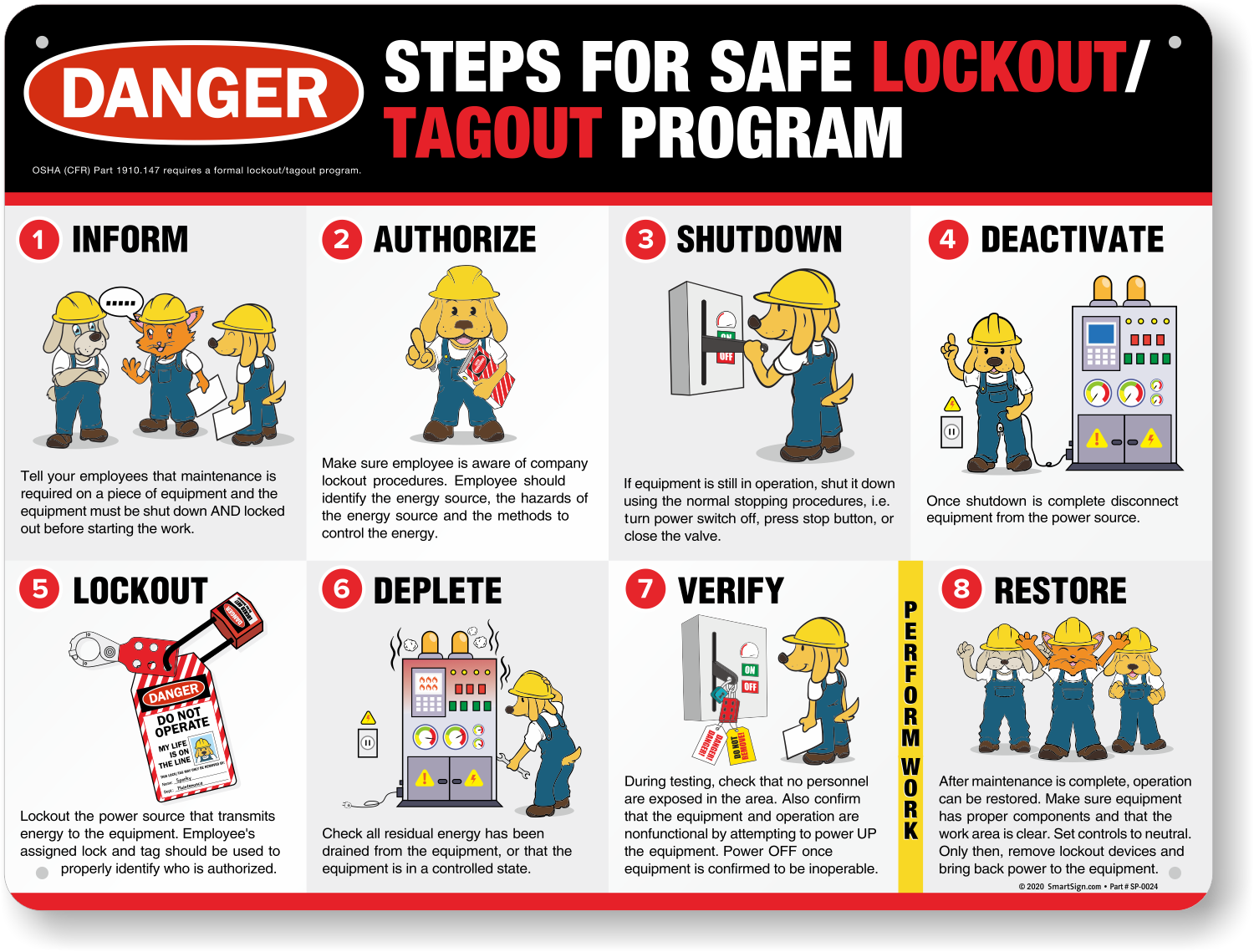
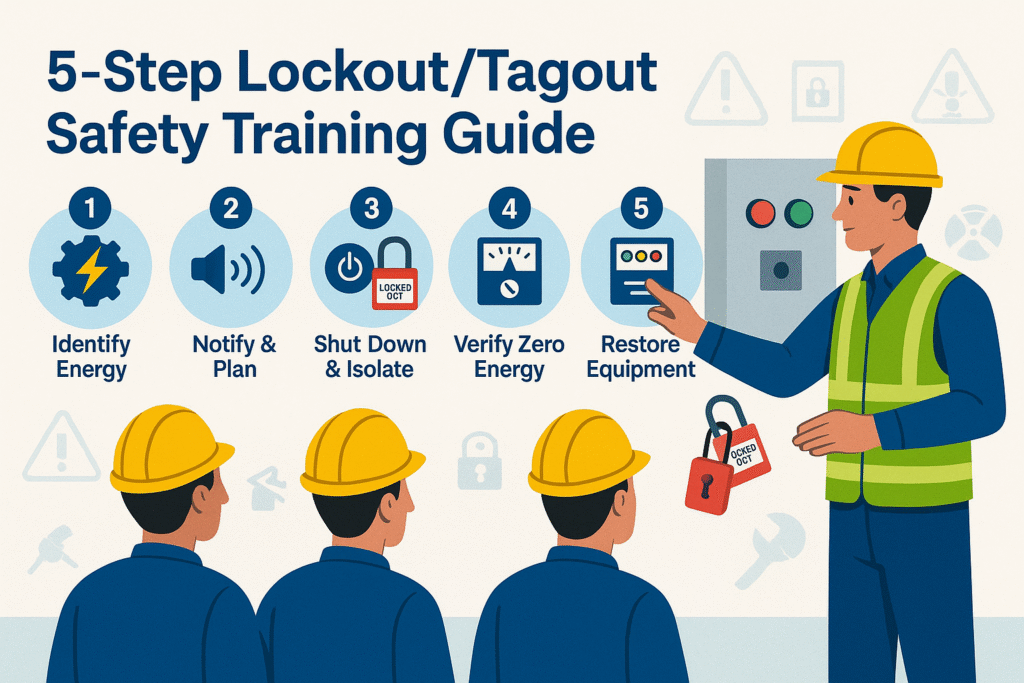
The 6-Step LOTO Safety Process That Actually Works
A reliable lock out tag out safety program follows a strict sequence. Deviating—even slightly—increases risk. Here’s the proven workflow:
1. Prepare for Shutdown Identify all energy types involved and the specific isolation points. Review the written LOTO procedure. Gather necessary locks, tags, and tools.
2. Notify Affected Personnel Inform all workers in the area that maintenance is starting. This prevents someone from unknowingly trying to use the machine.
3. Shut Down the Equipment Use normal stopping procedures. Never assume the machine is off just because it’s not running—verify.
4. Isolate Energy Sources Turn off and disconnect all energy supplies: electrical breakers, valve closures, blockades for moving parts. This includes secondary and stored energy.
5. Apply Locks and Tags Each authorized worker applies their personal lock and tag. No shared locks. No master keys. The lock must be durable and identifiable.
6. Verify Zero Energy State This step is non-negotiable. Attempt to start the machine (with proper precautions) or test for residual voltage, pressure, or motion. If energy remains, return to Step 4.
A steel mill in Pennsylvania reduced LOTO-related near-misses by 78% after adding verification logs—requiring workers to document proof of zero energy before beginning work.
Industry-Specific LOTO Applications and Risks
One-size-fits-all LOTO procedures fail because energy risks vary by environment.
Manufacturing High-risk areas include robotic arms, stamping presses, and conveyor systems. A common mistake is failing to lock out adjacent machinery that could activate interlocked systems. Solution: Expand LOTO coverage to interconnected equipment.
Construction Portable power tools and temporary power sources create unique challenges. A worker cleaning a concrete mixer must isolate both the main feed and any backup generators. LOTO here often involves chaining breakers in temporary distribution panels.
Healthcare Medical equipment like MRI machines or sterilizers contain strong magnetic fields and high-pressure steam. Lockout procedures must include quench protection and coolant isolation—often overlooked in standard training.
Utilities Electrical substations and pump stations involve multiple energy sources and remote controls. A near-miss in a Texas water treatment plant occurred when a valve auto-opened due to a PLC signal—despite local lockout. The fix: include control circuit isolation in LOTO steps.
Food Processing Wet environments increase electrical risk. Lockout points must be corrosion-resistant, and tags must remain legible. One poultry plant switched to waterproof, UV-resistant tags after routine washdowns erased critical warnings.
Essential Components of a Compliant LOTO Program
OSHA’s 29 CFR 1910.147 sets the legal standard, but compliance isn’t just about avoiding fines—it’s about creating a culture of safety.
A robust lock out tag out safety program includes:
- Written Procedures
- Detailed, machine-specific instructions. Not generic templates. Each should list energy types, isolation points, and step-by-step shutdown sequences.
- Authorized vs. Affected Worker Training
- Authorized workers (who perform LOTO) need in-depth training. Affected workers (who operate equipment) need to understand why they must never bypass a lock or tag.
- Periodic Inspections
- At least once a year, a supervisor must inspect each LOTO procedure and observe an employee applying it. The goal is to catch deviations before they cause harm.
- LOTO Devices That Meet Standards
- Use only locks and tags designed for safety use: non-releasable padlocks, standardized lockout hasps, and tags with durable, tamper-resistant materials.
- Clear Accountability
- Every lock must be traceable to a single employee. Lost keys should never be drilled out without a formal override protocol.
One aerospace manufacturer reduced LOTO violations by 90% simply by assigning color-coded locks by department—making unauthorized use instantly visible.
Common LOTO Devices and Tools You Should Know
Not all locks and tags are created equal. Choosing the right equipment matters.
| Device | Purpose | Best Use Case |
|---|---|---|
| Padlock (Keyed or Combination) | Primary lockout device | Individual control; must be unique to each worker |
| Lockout Hasp | Allows multiple locks on one point | Group maintenance tasks |
| Valve Lockout | Secures ball, gate, or butterfly valves | Piping systems, fluid control |
| Circuit Breaker Lockout | Prevents breaker activation | Electrical panels |
| Plug Lockout | Covers electrical plugs | Small machinery, portable tools |
| Energy Isolation Tags | Communicates shutdown status | Must include name, date, reason |
Invest in high-visibility tags with pre-printed warnings. Handwritten tags can be illegible or incomplete. Similarly, use locks with non-conductive bodies in electrical environments.
How to Audit and Improve Your LOTO System
A LOTO program isn’t “set and forget.” Regular audits reveal hidden flaws.
Start with a walkthrough: - Are locks present on all isolation points? - Are tags complete and legible? - Is stored energy properly bled or blocked? - Are group lockout procedures being followed?
Then conduct random observation audits: - Watch an authorized worker perform a full LOTO cycle. - Note deviations: skipped verification, missing notifications, improper device use.
Use findings to update procedures and retrain. One chemical plant used audit data to redesign their tag format—adding QR codes that linked to machine-specific LOTO videos.
Also, encourage anonymous reporting of LOTO concerns. Workers on the floor often see risks that managers miss.
Lock Out Tag Out Safety: A Culture, Not Just a Checklist
The most effective LOTO systems aren’t just followed—they’re respected. That comes from leadership modeling, consistent enforcement, and recognizing that every lock represents a life protected.
Start small: pick one high-risk machine and build a flawless LOTO procedure for it. Train everyone involved. Audit it monthly. Then scale.
When a maintenance technician in Ohio prevented a fatal accident by finding a missing lock during pre-work checks, the company didn’t just praise him—they updated their procedure to include a peer verification step.
That’s how safety evolves: not through compliance alone, but through vigilance, ownership, and real-world adaptation.
Lock out tag out safety works—but only if it’s treated as essential, not administrative. Implement it right, and you’re not just following OSHA. You’re building a workplace where no one has to wonder if the machine is really off.
What is the primary goal of lock out tag out safety? To protect workers by ensuring machines are fully de-energized and cannot be restarted during maintenance.
Can tagout be used without lockout? Only if the tagout system provides equivalent protection, which is rare. OSHA prefers lockout as the primary method.
Who is responsible for applying LOTO devices? Authorized employees who have been trained and are performing servicing or maintenance.
How often should LOTO procedures be inspected? At least annually, with documented reviews and employee observations.
What qualifies as hazardous energy? Electrical, mechanical, hydraulic, pneumatic, chemical, thermal, and gravitational energy sources.
Do all employees need LOTO training? Only authorized employees perform LOTO, but affected employees must understand its purpose and limitations.
What should a LOTO tag include? Worker’s name, date, reason for lockout, and a clear “Do Not Operate” warning.
FAQ
What should you look for in Lock Out Tag Out Safety: Protecting Workers from Hazardous Energy? Focus on relevance, practical value, and how well the solution matches real user intent.
Is Lock Out Tag Out Safety: Protecting Workers from Hazardous Energy suitable for beginners? That depends on the workflow, but a clear step-by-step approach usually makes it easier to start.
How do you compare options around Lock Out Tag Out Safety: Protecting Workers from Hazardous Energy? Compare features, trust signals, limitations, pricing, and ease of implementation.
What mistakes should you avoid? Avoid generic choices, weak validation, and decisions based only on marketing claims.
What is the next best step? Shortlist the most relevant options, validate them quickly, and refine from real-world results.